

Dr Thomas Fisher
Foot and Ankle Surgeon
Home › Conditions › Foot & Ankle › Bunions

Bunions are a common deformity with one in three women and one in ten men affected. They are thought to occur due to a genetic muscle imbalance and therefore tend to run in families.
Tight or high heeled shoes may exacerbate the condition however they are not the cause of them. Bunions worsen with time and can eventually cause pain and arthritis. The bunion may damage other parts of your feet and lesser toes as well. Pain is felt because of the foot’s increased width and the abnormal biomechanics.
Many operations for bunions have been tried over the years with varying levels of success. Most have failed due to high recurrence rates, excessive joint stiffness, or by transferring problems to other parts of the foot. Modern surgery solves many of these problems. The keys to success are the restoration of foot biomechanics, allowance for excellent joint motion and very low recurrence rates.
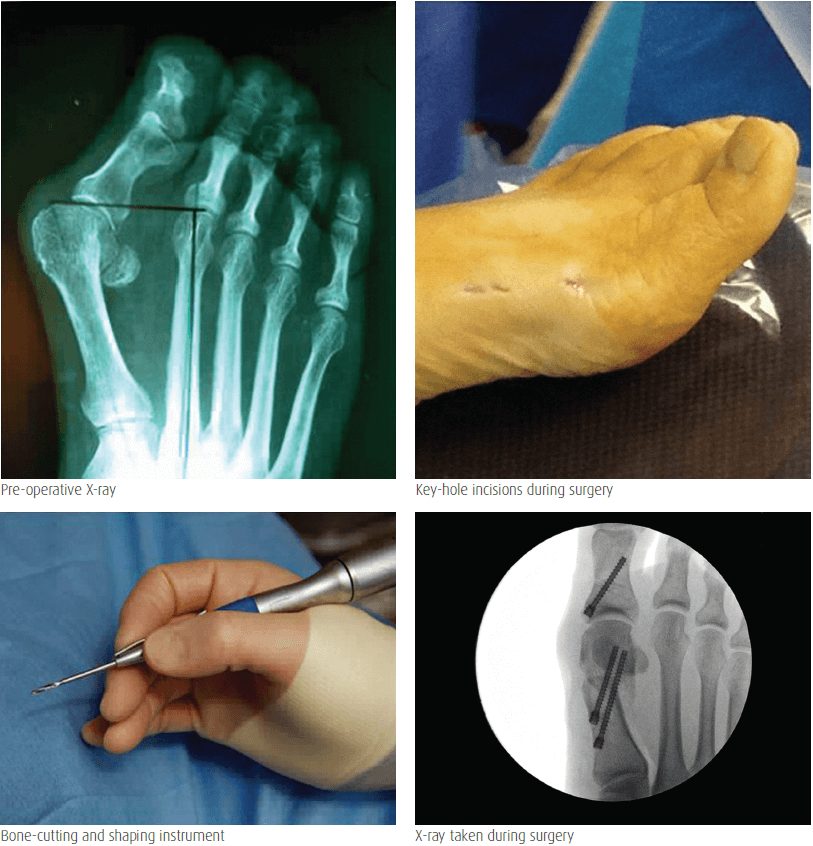
Over the last five to 10 years, minimally invasive surgical techniques (“keyhole surgery”) have been developed in France and Italy. It is known as the minimally invasive chevron and Akin (MICA) osteotomy and is carried out through several small keyhole incisions with x-ray guidance. Occasionally with more severe deformities, some excessive skin requires removal. This is the only time sutures are required, with smaller deformity corrections not requiring sutures at all. The screws used to hold the bones in place usually do not require removal.
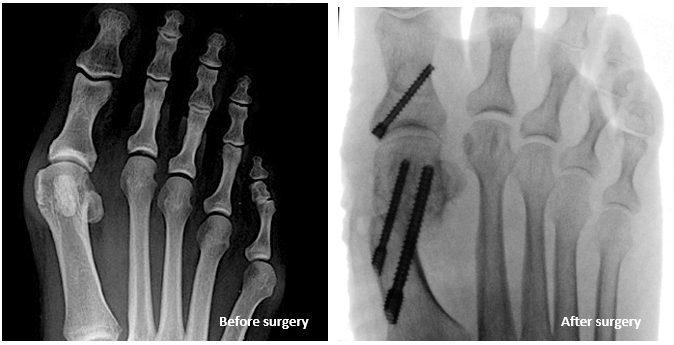
It is essentially very similar to open surgical techniques, however with much less soft tissue damage in the process. The advantages are generally less post-operative pain, improved cosmesis with smaller scars and less post- operative stiffness compared with bunions corrected with larger incisions.
Immediate weight bearing is possible in a flat, post-operative stiff soled shoe and plaster is not required. The way your foot has been bandaged assists in holding the big toe in place during healing. The post-operative shoe protects the toe when you walk and takes the place of a plaster. Accordingly, it is essential that it is worn for the first six weeks whenever standing or walking.
As with all foot surgery, swelling occurs and this is the main limitation to activity and footwear in the early stages. Swelling often increases over a six-week period and then reduces over a further six weeks. As such, your final result will begin three months after surgery. As the biomechanics in your foot have been substantially changed, your body will go on making subtle adjustments over a 12-month period.
Foot surgery without appropriate pain relief is extremely uncomfortable. While the operation is done under general anaesthetic, a nerve block is also performed, which puts the foot to sleep for around 24 hours. You should wake up from surgery with minimal pain and when the block wears off you can take simple tablet pain relief. It is important to start taking your pain relief prior to the block wearing off as once the pain becomes intense, it can become difficult to manage.
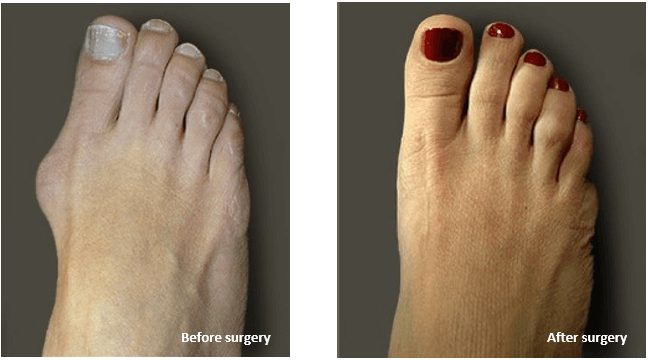
No surgery is risk free. The risks and complications will be assessed and discussed with you. There is always a small risk of infection, blood clots and anaesthetic problems with lower limb surgery, however comprehensive measures are taken to reduce such risks. In bunion surgery, there is also a 2% chance of recurrence of the deformity, overcorrection of the big toe or problems with bone fixation, and stiffness secondary to scar tissue. Very rarely, the toe can become numb or hypersensitive for a prolonged period. Conversely, there is generally at least 95% chance of a successful outcome.
Hospital stay Rest and elevation (when needed for comfort & balance) Walking aids Podiatrist (Exercises – non-weight bearing and weight bearing)
Time off work – Seated – Standing – Foot swelling
Shoes – Hospital (whenever standing or walking) – Comfortable – Fashion
Day surgery 7-10 days Up to 7 days 2-6 weeks
2-3 weeks 3-4 weeks 12 weeks
6 weeks 6-12 weeks 12 weeks

Written by
Foot and Ankle Surgeon
To make an appointment or enquiry with our Foot and Ankle Surgeon, Dr Anthony Nguyen and Dr Thomas Fisher, or a member of our foot and ankle team, contact the switchboard.
Who treats this
Foot and Ankle Surgeon

Hip, Knee and Ankle Surgeon
Keep reading
Ankle arthritis is a condition where the cartilage surfaces that line the ankle joint become thin and eventually wear out completely.
1,725 words
Hallux rigidus is the medical term used to describe a painful, stiff big toe. The name means stiff (rigidus) great toe (hallux).
1,045 wordsIn a first for South Australian foot and ankle healthcare, sportsmed are providing patients with challenging…
419 wordsAsk about foot & ankle when you callReception will put you with the right practitioner.
(08) 8130 1222